

$200 Billion in Hidden Housing Costs Is Reshaping US Homeownership in 2026
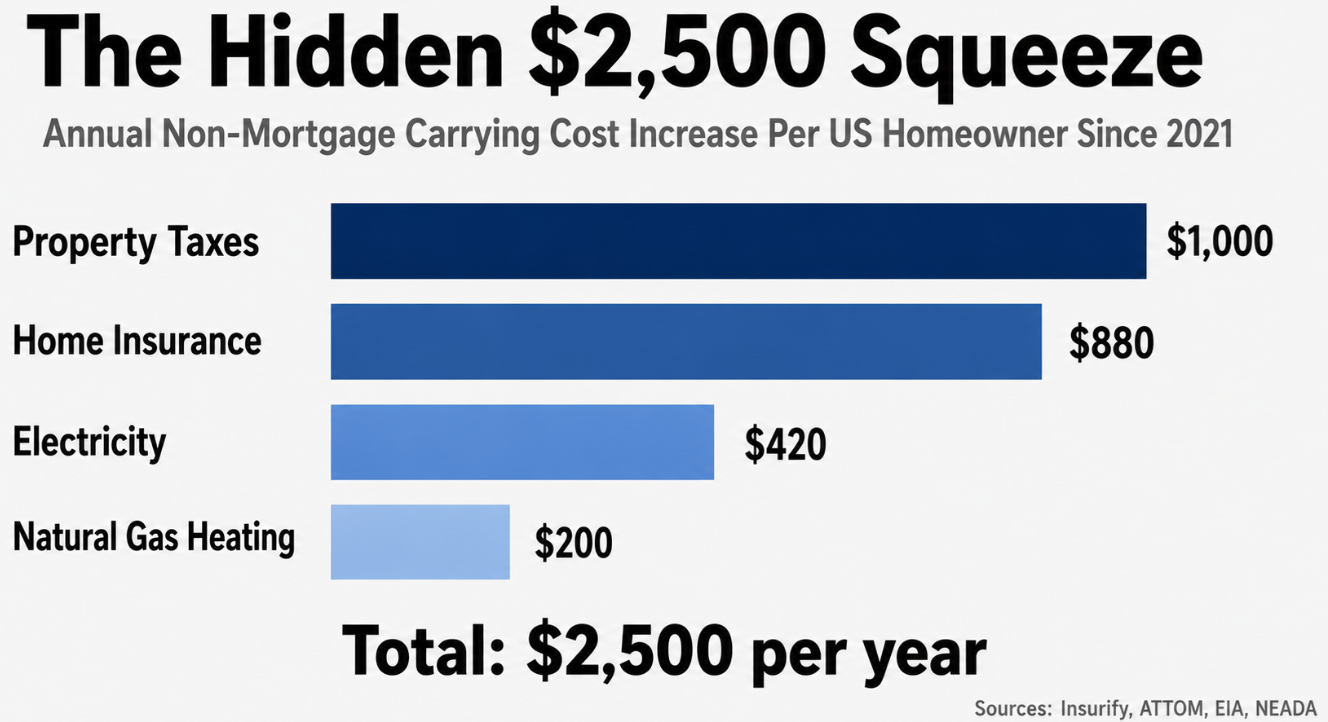
The Hidden $2,500 Squeeze: How Insurance, Property Taxes, and Utility Costs Are Reshaping US Homeownership Since 2021
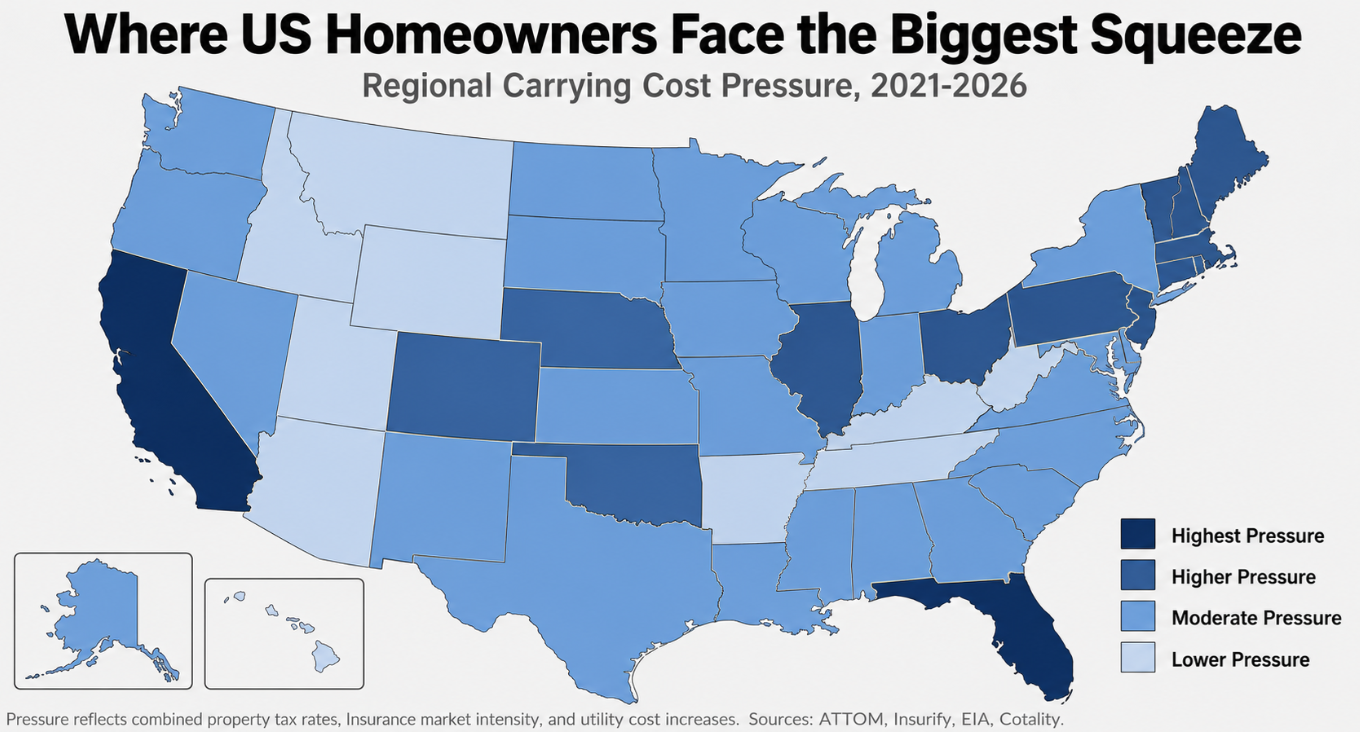
Regional Carrying Cost Pressure Across the United States, 2021-2026

Cumulative Percentage Increase in US Homeowner Carrying Costs by Component, 2021-2026
Insurance, property taxes, and utility costs have added roughly $2,500 per US homeowner since 2021, breaking the fixed-cost mortgage promise.
Insurance
Insurify projects the average annual US home insurance premium will reach 3,057 dollars by the end of 2026, up 4% from 2025. Premiums climbed 12% in 2025 alone and have risen 46% since 2021, roughly three times the rate of inflation. The Consumer Federation of America reports that premiums rose in 95% of US ZIP codes between 2021 and 2024. Insurance now consumes a growing share of monthly housing payments. The cost drivers are structural. Many property insurers have reported combined ratios above 100% in recent years, meaning they paid out more in claims and expenses than they collected in premiums. Reinsurance costs have risen significantly from 2021 through 2024. Rebuilding material and labor costs are up 40% since 2021 per the Insurance Information Institute. Florida remains the most expensive state at 8,292 dollars per year, driven by hurricane risk. Insurify projects California will see one of the largest 2026 increases at roughly 16%, reflecting losses from the Palisades and Eaton wildfires. Midwest states have seen 5-year cost increases of more than 35%, driven by severe convective storms producing 42 billion dollars in annual insured losses for three consecutive years.
Property Taxes
ATTOM's 2025 Property Tax Analysis shows homeowners paid 396.8 billion dollars in property taxes on 89.6 million US single-family homes in 2025, up 3.7% from 2024. The average single-family bill reached 4,427 dollars. The national effective property tax rate climbed to 0.9%, the highest since 2020. Tax bills rose in 40 states and the District of Columbia. LendingTree reports property taxes climbed in all 50 of the largest US metro areas between 2023 and 2024. ATTOM CEO Rob Barber noted that 2025 tax bills reflect more than just home values, underscoring the role of local government costs and shifting tax policies. Effective rates are highest in the Northeast and Midwest, with several states exceeding 1.2%, while Hawaii, Idaho, and Arizona remain below 0.5%.
Electricity and Heating
EIA data shows the national average residential electricity rate reached approximately 18 cents per kilowatt-hour in early 2026, up from 13.7 cents in 2021, a 31% increase. The average monthly bill climbed from 121 dollars in 2021 to 156 dollars in 2025, an additional 420 dollars per year. Drivers include grid replacement, weather hardening, and surging commercial demand from data centers. Utilities have committed roughly 1.4 trillion dollars in grid investment through 2030. New England rates average 30 cents per kilowatt-hour while parts of the Midwest and South remain below 13 cents. New generation capacity from natural gas, nuclear restarts, and renewables coming online by 2030 could ease pressure as supply catches up to demand. The National Energy Assistance Directors Association projects average US winter heating costs at 995 dollars for 2025-2026, up 9.2% from the prior winter. Natural gas heating costs have risen 26.5% over five years, adding roughly 200 dollars per year to the average heating bill.
The Combined Reality
The average US homeowner now pays roughly 2,500 dollars more per year in non-mortgage carrying costs than in 2021. Insurance accounts for roughly 880 dollars of the increase. Property taxes add roughly 1,000 dollars. Electricity adds roughly 420 dollars. Heating costs add roughly 200 dollars. Insurance and property taxes are typically built into monthly mortgage payments through escrow, which means annual escrow recalculations increase the monthly housing bill even when the mortgage rate is fixed. Utilities sit outside the mortgage as separate bills. Homeowners in states with higher effective property tax rates, expensive insurance markets, or rising utility costs can face 3,000 to 4,000 dollars or more in additional annual carrying costs. Homeowners in lower-cost states see closer to 1,500 to 1,800 dollars.
What It Means for Homeowners
When most homeowners budget for their monthly mortgage payment, they assume that figure stays roughly fixed for the life of the loan. That assumption no longer holds. Annual escrow recalculations push monthly housing costs higher each year as insurance and property tax increases flow through, even when the mortgage rate does not change. Utilities sit outside the mortgage but follow the same upward trajectory. The cumulative effect is most visible in the household budgets of retirees on fixed incomes and families balancing childcare, education, and other rising expenses. Across every US state, more homeowners now face a monthly housing bill that does not match the one they planned for at closing. The 52 trillion dollars in US household real estate continues to function as a wealth-building asset. But the cost of holding that asset has shifted upward, offsetting some of the payment stability traditionally associated with the 30-year fixed-rate mortgage.
About
Buys Houses is a Pittsburgh-based home buying company serving Western Pennsylvania, including Allegheny, Washington, Beaver, and Westmoreland Counties. The company works with property owners facing complex situations: inherited homes, probate cases, foreclosure timelines, out-of-state heirs, properties requiring substantial repairs, and owners needing to relocate quickly. As people who buy houses as is, Buys Houses provides a fast cash offer for properties in any condition, including homes needing substantial repairs, and works on a timeline set by the seller. We buy houses across Western Pennsylvania on the seller's timeline. More information at BuysHouses.co.
Carlo Finotti
Buys Houses
+1 412-561-9833
media@BuysHouses.co
Legal Disclaimer:
EIN Presswire provides this news content "as is" without warranty of any kind. We do not accept any responsibility or liability for the accuracy, content, images, videos, licenses, completeness, legality, or reliability of the information contained in this article. If you have any complaints or copyright issues related to this article, kindly contact the author above.
